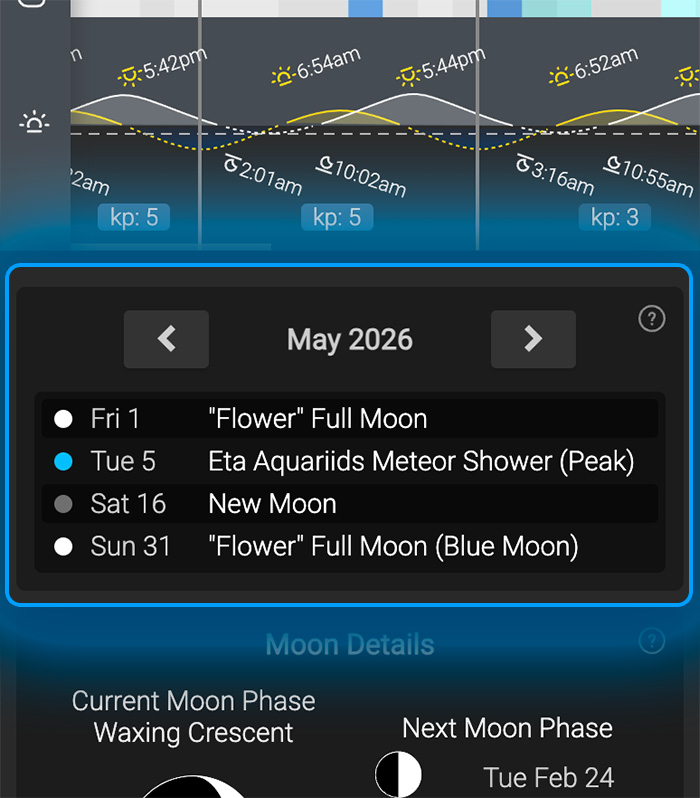
The Astrospheric Astronomy Calendar automatically detects and displays celestial events customized for your current forecast location.
With Smart Notifications, you'll receive alerts before significant events occur so you never miss an opportunity to observe.
All events are calculated and are tailored to your specific location.
Best viewing times consider factors like object altitude, darkness, and proximity to the actual event time.
Notifications are processed on Astrospheric's server using your device's last known coordinates. If you don't share device location,
then the server will attempt to process notifications based on the last forecast location you viewed in the app.
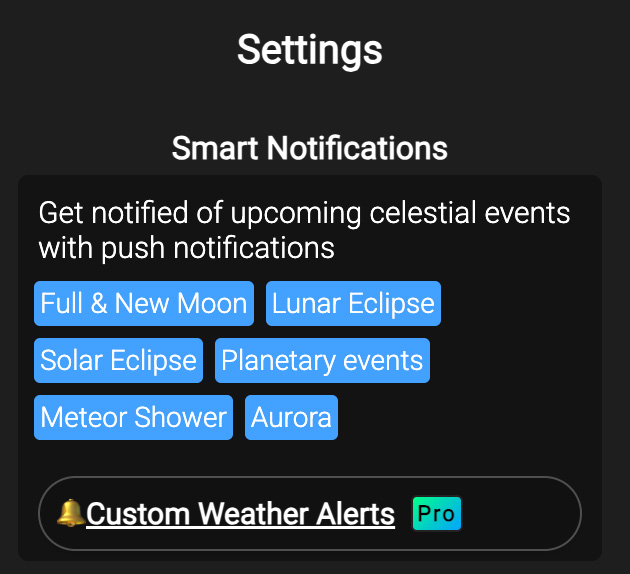
Smart Notification options can be managed in Astrospheric's side menu and rely on your device's push notification permissions and Do Not Disturb settings.
Below is a detailed breakdown of the types of events included in the calendar, how they're calculated, and when notifications are sent.
The calendar doesn't show Aurora events since aurora activity isn't predictable far in advance. However, the Smart Notification
system monitors real-time aurora data and KP index forecasts and will send you a notification if aurora viewing might be possible at your location.
Aurora — KP Index Forecast
Detection:
Monitors the forecasted KP index. If a KP value of 5 or higher is predicted and your device is north of the corresponding KP boundary line, you may receive a notification.
Conditions:
The sun must be below -12° at your location at the forecasted time (dark skies required).
📱 Smart Notification Timing
Sent as soon as a qualifying KP forecast is detected for your location. If the forecasted event is more than 24 hours away, the notification is scheduled for 10am local time. At most one KP notification per 24 hours per device.
Aurora — Real-Time Ovation
Detection:
Monitors the real-time aurora ovation forecast oval. If the ovation prediction exceeds 50% probability at your location, you may receive a notification.
Conditions:
The sun must be below -12° at your location at the forecast time (dark skies required).
📱 Smart Notification Timing
Sent immediately when a qualifying ovation forecast is detected. At most one ovation notification per 12 hours per device.
The calendar tracks the primary lunar phases that are most relevant for astronomers and photographers.
Full Moon
Detection:
Calculated using precise lunar phase angle (180°). The exact moment when the Moon is fully illuminated as seen from Earth.
Calendar Display:
Shows the date and exact UTC time of full illumination.
📱 Smart Notification Timing
Sent within 48 hours of the full moon. If the event is more than 24 hours away, delivered around 10am local time. If within 24 hours, sent immediately.
New Moon
Detection:
Calculated using precise lunar phase angle (0°). The exact moment when the Moon is between Earth and Sun.
Calendar Display:
Shows the date and exact UTC time. New moons are ideal for deep-sky observing due to dark skies.
📱 Smart Notification Timing
Sent within 48 hours of the new moon. If the event is more than 24 hours away, delivered around 10am local time. If within 24 hours, sent immediately.
The calendar includes 11 major annual meteor showers. Each shower's timing is calculated using the Sun's ecliptic longitude for precise peak predictions.
Tracked Meteor Showers
- Quadrantids (January) — ZHR ~80, very sharp peak
- April Lyrids (April) — ZHR ~18, reliable spring shower
- Eta Aquariids (May) — ZHR ~50, fast meteors with persistent trains
- Southern Delta Aquariids (July-August) — ZHR ~25, best from lower latitudes
- Perseids (August) — ZHR ~100, one of the best annual showers
- Orionids (October) — ZHR ~20, fast bright meteors
- Southern Taurids (October-November) — ZHR ~7, known for fireballs
- Northern Taurids (November) — ZHR ~5, slow meteors with fireball potential
- Leonids (November) — ZHR ~10, very fast meteors
- Geminids (December) — ZHR ~120, often the strongest annual shower
- Ursids (December) — ZHR ~10, far-northern radiant
Detection:
Peak time calculated from Sun's ecliptic longitude. Start and end dates define the active window.
Calendar Display:
Shows peak date, ZHR (Zenith Hourly Rate), radiant position, and Moon illumination percentage to help assess viewing conditions.
📱 Smart Notification Timing
Up to 3 notifications per shower:
- 2 weeks before peak: Advance notice, delivered around 10am local time
- 1 week before peak: Reminder with viewing details, delivered around 10am local time
- Day of peak: Final reminder sent immediately, with best viewing night and Moon illumination info
Planetary events include close approaches, elongations, oppositions, and seasonal markers.
Events are filtered for visibility and observability from your location.
Planet-Planet Close Approach
Planets Tracked:
Mercury, Venus, Mars, Jupiter, Saturn
Detection Criteria:
- Angular separation less than 2.0° between any two planets
- Searches ±14 days beyond month boundaries to find the closest approach
- Both planets must be at least 10° above the horizon
- Sun must be at least 6° below the horizon (civil twilight or darker)
- Planets must be more than 10° away from the Sun
Best Viewing Time:
Optimized for times closest to the actual closest approach while both objects are visible. Prioritizes proximity to the event over maximum altitude.
📱 Smart Notification Timing
Sent within 72 hours of the event. If the event is more than 24 hours away, delivered around 10am local time. If within 24 hours, sent immediately.
Moon-Planet Close Approach
Planets Tracked:
Mercury, Venus, Mars, Jupiter, Saturn
Detection Criteria:
- Angular separation less than 3.0° between the Moon and a planet
- Moon illumination must be at least 10% (crescent or greater)
- Searches ±14 days beyond month boundaries to find the closest approach
- Planet must be at least 10° above the horizon
- Moon must be at least 5° above the horizon
- Sun must be at least 6° below the horizon
Best Viewing Time:
Optimized for times closest to the actual closest approach while both the Moon and planet are visible.
📱 Smart Notification Timing
Sent within 72 hours of the event. If the event is more than 24 hours away, delivered around 10am local time. If within 24 hours, sent immediately.
Maximum Elongation
Planets:
Mercury, Venus (the inferior planets)
Detection:
Uses the SearchMaxElongation algorithm to find when Mercury or Venus reaches its greatest angular distance from the Sun. These are the best times to observe these planets as they're highest above the horizon at sunrise or sunset.
Calendar Display:
Shows the elongation angle and whether it's an eastern elongation (visible in evening sky) or western elongation (visible in morning sky).
📱 Smart Notification Timing
Sent within 72 hours of maximum elongation. If the event is more than 24 hours away, delivered around 10am local time. If within 24 hours, sent immediately.
Planet Opposition
Planets:
Mars, Jupiter, Saturn, Uranus, Neptune (the superior planets)
Detection:
Calculated when a planet's ecliptic longitude differs from the Sun's by exactly 180°. At opposition, the planet is closest to Earth, brightest, and visible all night long.
Calendar Display:
Shows the exact date and time of opposition. This is typically the best time of year to observe that planet.
📱 Smart Notification Timing
Sent within 72 hours of opposition. If the event is more than 24 hours away, delivered around 10am local time. If within 24 hours, sent immediately.
Equinoxes & Solstices
Events:
- Spring Equinox (March) — Day and night approximately equal length
- Summer Solstice (June) — Longest day, shortest night
- Fall Equinox (September) — Day and night approximately equal length
- Winter Solstice (December) — Shortest day, longest night
Detection:
Precise astronomical calculations of the Sun's position relative to the celestial equator.
📱 Smart Notification Timing
Sent within 72 hours of the event. If the event is more than 24 hours away, delivered around 10am local time. If within 24 hours, sent immediately.
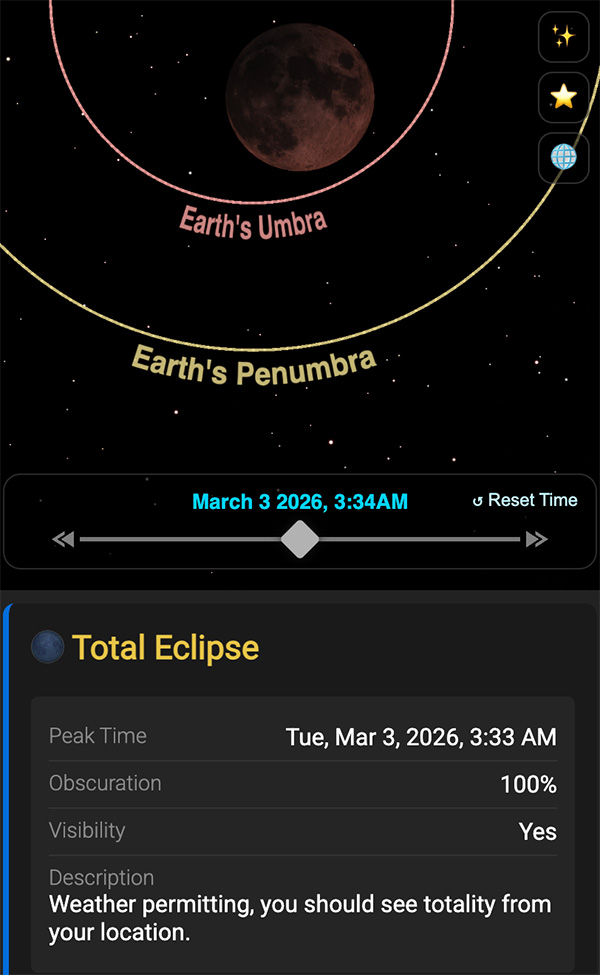
Lunar eclipses occur when the Moon passes through Earth's shadow. They are visible from anywhere the Moon is above the horizon during the eclipse.
Total Lunar Eclipse
Detection:
The Moon passes completely through Earth's umbral shadow. The Moon often appears reddish during totality ("Blood Moon").
Visibility Check:
The calendar calculates whether any part of totality is visible from your location based on the Moon's altitude during the eclipse phases.
📱 Smart Notification Timing
Up to 3 notifications per eclipse:
- 2 weeks before: Advance notice, delivered around 10am local time
- 1 week before: Reminder with visibility details for your location, delivered around 10am local time
- Day of: Final reminder sent immediately with specific timing
Partial Lunar Eclipse
Detection:
Only part of the Moon passes through Earth's umbral shadow. The obscuration percentage indicates how much of the Moon is covered.
Calendar Display:
Shows obscuration percentage and whether the partial phases are visible from your location.
📱 Smart Notification Timing
Same schedule as total eclipses — up to 3 notifications at 2 weeks, 1 week, and day of.
Penumbral Lunar Eclipse
Detection:
The Moon passes through Earth's lighter penumbral shadow. These are subtle events where the Moon appears slightly dimmer.
Calendar Display:
Shown on the calendar for completeness.
📱 Smart Notification Timing
Notifications are not sent for penumbral eclipses as they are difficult to observe visually.
Solar eclipses occur when the Moon passes between Earth and the Sun. Visibility depends heavily on your geographic location.
Total Solar Eclipse
Detection:
The Moon completely covers the Sun's disk. Totality is only visible from a narrow path on Earth's surface.
Local Observation:
The calendar calculates your specific viewing circumstances including local peak time, obscuration percentage, and whether you're in the path of totality.
📱 Smart Notification Timing
Up to 3 notifications per eclipse:
- 2 weeks before: Advance notice with visibility info, delivered around 10am local time
- 1 week before: Reminder with local obscuration percentage, delivered around 10am local time
- Day of: Final reminder sent immediately with exact local timing
Annular Solar Eclipse
Detection:
The Moon is too far from Earth to completely cover the Sun, creating a "ring of fire" effect. Like total eclipses, annularity is only visible from a narrow path.
Calendar Display:
Shows global eclipse information plus your local observation details.
📱 Smart Notification Timing
Same schedule as total solar eclipses — up to 3 notifications at 2 weeks, 1 week, and day of.
Partial Solar Eclipse
Detection:
Only part of the Sun is covered by the Moon. May occur when you're outside the path of a total/annular eclipse, or during eclipses that are only partial globally.
Calendar Display:
Shows the maximum obscuration percentage visible from your location and the timing of the partial phases.
📱 Smart Notification Timing
Same schedule as other solar eclipses — up to 3 notifications at 2 weeks, 1 week, and day of, with local obscuration details included.
⚠️ Safety Warning
Never look directly at the Sun during a solar eclipse without proper solar filters or eclipse glasses.
Even during a partial eclipse, the Sun's rays can cause permanent eye damage.
Astronomy notifications can be enabled or disabled in Astrospheric's settings. Each event type can be toggled individually.
Notification Types
- Aurora — Real-time aurora ovation and KP index forecast alerts
- Moon Phases — Full and new moon alerts
- Meteor Showers — Peak night reminders
- Planetary Events — Close approaches, elongations, oppositions
- Lunar Eclipses — Visible lunar eclipse alerts
- Solar Eclipses — Solar eclipse alerts for your location
Delivery Timing
Standard Delivery:
Most notifications are delivered around 10am local time on the day(s) before the event.
Day-Of Delivery:
For events happening within 24 hours, notifications may be sent immediately or at the next appropriate window.
Quiet Hours:
Notifications respect your device's Do Not Disturb settings.